Until Proven Safe: The History and Future of Quarantine by Geoff Manaugh & Nicola Twilley
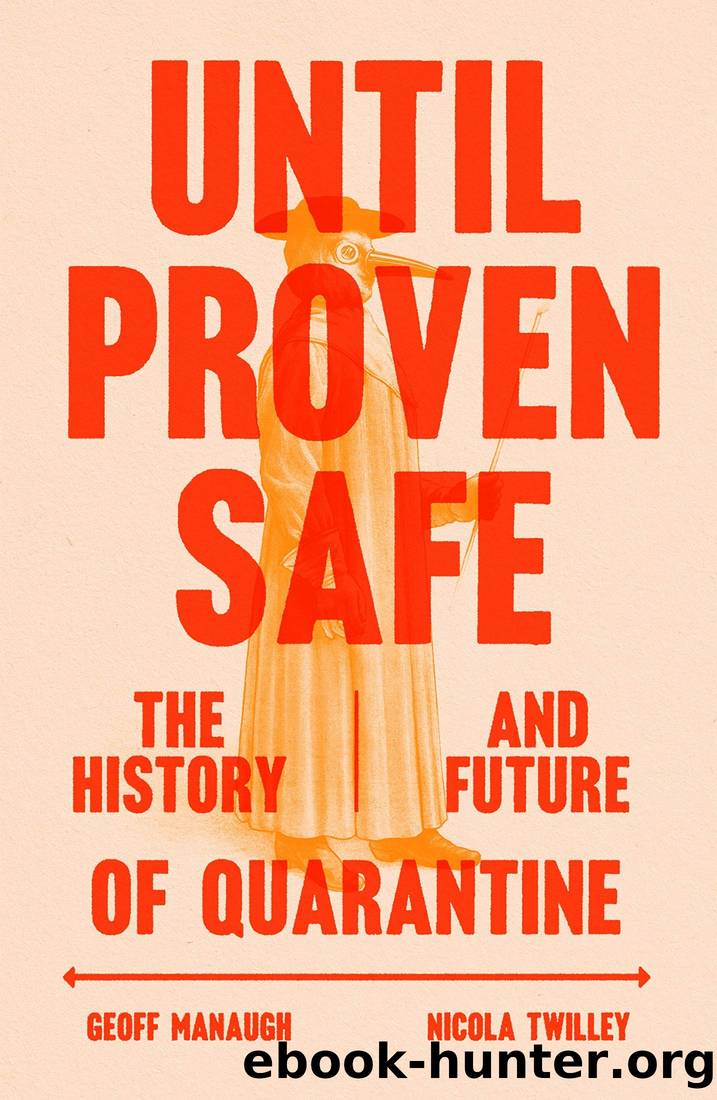
Author:Geoff Manaugh & Nicola Twilley [Manaugh, Geoff & Twilley, Nicola]
Language: eng
Format: epub
ISBN: 9780374715335
Google: fVP2DwAAQBAJ
Published: 2021-07-20T10:03:32+00:00
* * *
Despite these efforts, the primary way that infectious material is expected to leave NBAF is due to human errorâthe Achilles heel of lazarettos throughout history. âEveryone will tell you it always comes down to the people,â said Trewyn. NBAF will implement continuous training, voluminous record-keeping requirements, and a buddy system, but staff will not be allowed to keep chickens at home, on the off chance they bring home a pathogen that jumps species. (A disease that becomes avian is always of elevated concern, simply because of how easily it can move across borders.)
Everyone who works at NBAF will also be subject to background screening and security checks, to mitigate the possibility of an insider threat; the building is designed so that advancing deeper into containment involves passing through concentric rings of facial recognition and PIN-code checkpoints. Trewyn told us that, on the recommendation of a Navy SEAL white-hat security team, the university is already moving its Purebred Beef Unit, which offers students hands-on training in the cattle industry, to a new location, farther away from NBAF. âSomebody could poison the animals, once NBAF is up and running, and it would have nothing to do with NBAF, but that would be the perception,â he explained.
In yet another report, the National Research Council complained that the Department of Homeland Securityâs risk assessment was âbased on overly optimistic and unsupported estimates of human error rates.â (The DHS assessment didnât even attempt to quantify the likelihood of malicious or deliberate acts.) Certainly, Plum Island has had a handful of documented close calls, as have other such facilities around the world. But Trewyn believes that the risk of accidental pathogen escape, in all its uncertainty, is worth taking, based on the probability that these diseases will arrive in the United States anyway and cause equally incalculable damage.
As an example, he pointed us, once again, to the U.K. In 2007, when foot-and-mouth escaped from the Pirbright Institute, an animal-disease research facility, into the Surrey countryside, thanks to a combination of heavy rains and aging pipework, it was quickly caught and contained. Within hours of the first case, all livestock movement in the entire country had been brought to a halt, and the virus was mopped up within two months, after infecting just eight farms. The system worked, Trewyn concluded, especially when compared with a very different incident just six years earlier.
That outbreak began in Northumberland, in 2001, when contaminated pork that had likely been illegally imported from Asia was fed to a herd of pigs in improperly sterilized swill, triggering a national epidemic of foot-and-mouth disease that lasted nearly a year and led to the death of six million sheep, pigs, and cattle, and at least sixty farmer suicides. Soldiers were brought in to assist with the mass slaughter of affected herds, and, following footage of the British countryside alight with animal pyres and bulldozers shoveling rigid carcasses into huge piles for incineration, tourism dropped by 10 percent.
Calculating the cost of such an outbreak
Download
This site does not store any files on its server. We only index and link to content provided by other sites. Please contact the content providers to delete copyright contents if any and email us, we'll remove relevant links or contents immediately.
The Art of Coaching by Elena Aguilar(53415)
Thinking, Fast and Slow by Kahneman Daniel(12416)
The Art of Thinking Clearly by Rolf Dobelli(10597)
The 5 Love Languages: The Secret to Love That Lasts by Gary Chapman(9895)
Mindhunter: Inside the FBI's Elite Serial Crime Unit by John E. Douglas & Mark Olshaker(9418)
When Breath Becomes Air by Paul Kalanithi(8506)
Periodization Training for Sports by Tudor Bompa(8329)
Becoming Supernatural by Dr. Joe Dispenza(8277)
Turbulence by E. J. Noyes(8112)
Bodyweight Strength Training by Jay Cardiello(7968)
Nudge - Improving Decisions about Health, Wealth, and Happiness by Thaler Sunstein(7758)
Therapeutic Modalities for Musculoskeletal Injuries, 4E by Craig R. Denegar & Ethan Saliba & Susan Saliba(7744)
The Road Less Traveled by M. Scott Peck(7660)
Mastermind: How to Think Like Sherlock Holmes by Maria Konnikova(7428)
Enlightenment Now: The Case for Reason, Science, Humanism, and Progress by Steven Pinker(7353)
Win Bigly by Scott Adams(7255)
Kaplan MCAT General Chemistry Review by Kaplan(6988)
Why We Sleep: Unlocking the Power of Sleep and Dreams by Matthew Walker(6782)
The Way of Zen by Alan W. Watts(6669)
